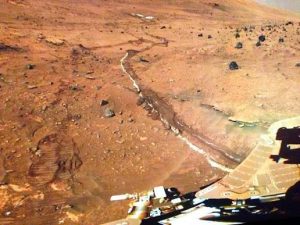
More than a year after NASA’s Perseverance rover found a strong biosignature candidate in a Martian geological formation, the scientists studying the data have announced that they have been unable to find a non-biological explanation for the existence of the distinctive formations, meaning that Mars—at least at some point in the planet’s history—was home to biological lifeforms!
In July 2024, while exploring Mars’ Bright Angel geological formation, NASA’s Perseverance roverdiscovered millimeter-size white “leopard spots” on the surface of a reddish rock called Cheyava Falls that were found to contain organic compounds. Additionally, these leopard spots were rimmed with black edges that contain iron and phosphate. Phosphate compounds are crucial for the formation of DNA, and are part of the makeup of adenosine triphosphate, or ATP, a compound responsible for transporting metabolic energy throughout the body.
On Earth, these patterns would be signatures left behind by microbes as they metabolize the organic carbon, sulfur and phosphorous—raw materials that are all present in the formation—for energy. Two specific iron-rich minerals that are produced by microbes—vivianite (hydrated iron phosphate) and greigite (iron sulfide)—were present in the spots; between their visual appearance and chemical composition, the presence of the leopard spots suggested that they had been formed by biological lifeforms.
When the discovery of Cheyava Falls’ potential biosignature was announced last year, the researchers cautioned that, despite the distinctive appearance of the formations, the individual compounds that form the patterns can be produced abiotically. But in the time since the initial announcement, the researchers haven’t been able to confirm the presence of the geological or chemical conditions that would be required for them to form without biological assistance.
What’s more, Cheyava Falls is one of the youngest geological formations that Perseverance has studied, suggesting that Mars may have been habitable for much longer than originally assumed, with life possibly having thrived there for over a billion years.
“If the Cheyava Falls results ultimately do lead to the proof of ancient life on Mars… that means two different planets hosted microbes getting their energy through the same means at about the same time in the distant past,” geologist Michael Tice remarked in a National Geographic article “That could suggest that early life learns how to survive in this way regardless of where it originated.”
“This finding by Perseverance… is the closest we have ever come to discovering life on Mars,” according to a statement released by acting NASA Administrator Sean Duffy. “The identification of a potential biosignature on the Red Planet is a groundbreaking discovery, and one that will advance our understanding of Mars.”
Although the samples collected by Perseverance were expected to be retrieved by the NASA-ESA Mars Sample Return mission, the project has been put on hold due to its high cost. NASA is currently looking to private space exploration companies for less expensive solutions; hopefully the samples will one day be examined by a laboratory so that human eyes can view the fossils of genuine Martian lifeforms—or perhaps their still-thriving descendants…