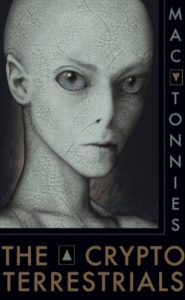
Mac Tonnies, who died in 2010 at the age of 35, was a genius. Simple as that. His 2010 book The Cryptoterrestrials (published shortly after his untimely death) reads, as Whitley and Mac’s friend Greg Bishop say in this show, like a book that should

have been published in 2025. And maybe that’s what Mac wanted when an astonishing event happened at the 2025 Contact in the Desert gathering. In the show, Whitley explains the event, and for our video viewers, shows the ultra-high strangeness origin of the haunting image of Mac you see on the right. Then Whitley and Greg respect what we believe to be a direct request from Mac, and provide an in-depth discussion of The Cryptoterrestrials.
Mac died in his sleep of a heart arrhythmia. He left behind the memories of his friends and this brilliant, astonishing book. Its discussion of what our visitors may really be mirrors the very latest thinking on the subject–fifteen years ahead of time.
Next week, we discuss the reality of the afterlife with author Chris Carter. There is every evidence that, as Anne Strieber put it, “what we call the dead” are coming closer to us. Dreamland and Unknowncountry acknowledge this and honor it.
Don’t miss a single minute of this one!
Get the Cryptoterrestrials. Click here.
Not an Unknowncountry subscriber? Now’s the time! Click here.
Dreamland is delayed this week because Whitley wanted to be with his family in Texas. Nobody was injured in the catastrophe, but he wanted to be with them.
16 Responses
Phew, I was starting to get worried about this week’s show but boy was it worth the wait.
I read Mac’s book back in around 2013/14 and it significantly altered my perspective of what may be going on with possible parallel civilisations around us. For a year or so I pondered Mac’s suggestions and enjoyed a sense of awe.
Then, I forget when exactly, I thought I saw, just for a split second, in the bathroom mirror, one of these people, a Woman in fact, standing behind me. Her eyes were unmistakable and she certainly wasn’t ‘from round here’ (a small village deep in the English countryside). If she walked down the street she would get looks, that is if she wasn’t mind controlling other people’s perception.
Imagination? Perhaps, but it never happened again and it had been a year or two after reading the book, maybe longer, not sure. Hmm…I’m staying open minded but my instinct tells me that she was from a higher plane so, who knows how this works?
Mac was indeed a brilliant man. Equally, I much enjoyed Timothy Good’s account of experiencing telepathy with ‘a visitor’ in a restaurant in the US when he was on an orchestral tour. I’ll not spoil that account, it’s worth reading in full if you can find it.
Peace.
Moody Blues 1968 In Search of the Lost Chord”
[Verse 1]
And you can fly
High as a kite if you want to
Faster than light if you want to
Speeding through the universe
Thinking is the best way to travel
[Verse 2]
It’s all a dream
Light passing by on the screen
And there’s you and I on a beam
Speeding through the universe
Thinking is the best way to travel
[Verse 3]
We ride the waves
Distance is gone, will we find out
How life began, will we find out?
Speeding through the universe
Thinking is the best way to travel
[Verse 4]
And you can fly
High as a kite if you want to
Faster than light if you want to
Speeding through the universe
Thinking is the best way to travel
Thank you for this.
Whitley,
I was able to see a face in that “color distortion” on the photo and I am blown away by the entire story leading to today’s podcast/video! So much so that I actually purchased Mac’s audio version of his book, “ THE CRYPTOTERRESTRIALS: A Meditation on Indigenous Humanoids and the Aliens Among Us!” I don’t believe in coincidences and I agree that Mac found a way to get the message across that his book should be brought forward again and what a better place than at your conference, where you and other friends of his would actually recognize he was sending that exact message! This is fabulous. I love it. This story is one of those that can’t be denied.l! Stories like this one makes me so happy! Plus, I love this website. I love all of your books Whitley. I’ve been a fan for many many years and I’m so grateful you continue with your incredible podcast and Ann’s beautiful website.
Much love!💕
Karen Walker
“It becomes a master when it should be a servant.”
Thank you
Many years ago I had a dream that an intelligent machine would become immensely powerful and try to destroy us when we became its assistants instead of it ours. Our only recourse at that point was to run away.
I remember Mac Tonnies…Jeremy Vaeni also posted an old interview with Tonnies on ‘The Experience’ after Tonnies passed. There was also lots of back-and-forth in the comments section on the show too. It did leave an impression on me. I’ll be listening to this week’s Dreamland later today, but for those that are interested, you can listen to Jeremy’s old interview with Tonnies here:
https://unknowncountry.com/the-experience/tribute-to-the-amazing-mac-tonnies/
One more thing: When you look up ‘The Cryptoterrestrials’ on Amazon, it shows a picture of Mike Clelland as the book’s author!
Thx for this link Cosmic, I shall listen to it while taking breakfast tomorrow.
Timing sure is mysterious at the moment..
After watching this discussion, a lot stood out for me, because of my own experiences. A good friend of mine, who is also a denizen here at Unknown Country, and I have discussed our place once the presence of the ‘others’ cannot be denied. We know that our job will be to help others get through the ontological shock, while also dealing with it ourselves with as much grace as possible.
Also, it’s wise to point out the importance of indigenous peoples. I subscribed, and I’m learning a lot about the Dine (Navajo), their customs, language, and belief system. For those familiar with Skinwalkers and Skinwalker Ranch, so much begins to fall into place. If you want a free taste via YouTube videos, this is a good place to start:
https://www.youtube.com/channel/UCbclNKC4fLzci5Io_rYVJ1Q/videos
I had been watching Wally Brown’s videos on YouTube a long time before I took the plunge and decided to learn more. The Lakota also have a wealth of information. These indigenous peoples have been dealing with all this for many hundreds or even thousands of years, while most Americans are relative newbies, only facing this in the last 80 years or so…and not just in America. Indigenous peoples around the world have wisdom to share that could be beneficial.
Mac Tonnies’ death was a shock when it happened. I do think it’s rather interesting that his face showed up when and how it did…and I thought it was funny that when I went to Amazon to look up ‘The Cryptoterrestrials’, Mike Clelland’s picture and name showed as as the author, so that Trickster element is par for the course!
While waiting for this episode, I listened to an old one from November 2000, an interview with Nancy Redstar, who had written “Star Ancestors,” about Native peoples’ history with the Visitors.
The interview went a bit off in places, and also, it was a call-in show in those days and some callers were way, way out there, not in a useful way. But I’d like to follow up and know more about this subject.
I seem to remember Whitley mentioning that one culture spoke of the Grays as “ants,” I think ants that came up from the earth if I remember correctly. It sounds like an apt description of their appearance.
The Ant People are talked about by the culture of the Hopi.
You were ahead of your time, Mac!
The theme of the visitors wanting disclosure to not be a top-down thing for the government to give to us, and for it to instead to be about true democracy, about each of us, was raised.
This got me to realizing how the emotional pressure we feel within that wants disclosure from government: is not a healthy part of us.
It’s a part of us that seeks reality as an externalized thing.
How can you direct someone to make contact with the divine within if the top-down relationship between a common person and cultural authority is strong and valid?
Part of the secrecy absolutely is
to slowly breakdown, mock, make ridiculous trust in government as an authority of reality.
Why?
To breakdown within us an anxious insecure dependency in looking to the government, existing cultural authorities, and peers to validate reality for us.
It’s a compassionate attempt to obliterate our basis of seeing ourselves as external from reality, as individual concepts external to the reality. A way of “seeing” of life that makes us constantly living spell-bound seeking externalized validation from others. For externalized validation, one believes, is the means through which one can relieve their existential disconnection from reality. And if externalized validation is received one briefly does feel good. In the end: the externalized validation floods the brain with reward chemicals (dopamine, serotonin, oxytocin, etc.) and only hardens the original premise that one is separate. Thus: we mostly only know loops of suffering, never getting true relief from existential disconnection we feel on a deep level.
Of course: the visitors themselves can’t become externalized things for us to turn to either. This explains the necessity of mixed signals and constant confusion, and their non-intervention. Whitley has really brilliantly articulated this point.
I’ve never depended on my government to be honest and forthcoming about anything, so I’m with you 100%, and that includes ‘disclosure’. It could be (would be) used as a tool tool to control and manipulate people even more than they are now. At this time in particular, it would be a disaster. I don’t need ‘official’ disclosure.
I love Whitley’s articulation of the risk of “cultural colonization” the visitors are wary of they may cause.
However, we’re blind to seeing how the same threats of cultural colonization that the visitors may pose has already devastatingly happened to us.
Our felt sene of connection in a singular awareness has been deeply hamstrung to utterly seeing ourselves as just human beings.
Our felt sense of divinity within, and without, has been colonized by human brains looking for charges of power. Connection is conditioned and taught not to be seen as inherent, but something one must receive and get from another. And it’s not just the upper echelons of culture doing this; we do it to each other.
Cultural or social validation, and importantly; even just imagining it, triggers dopamine and other satisfying brain chemical thus conditioning a sense of reward for restless behavior and how to relieve it. Loops thus forge that near impenetrably preoccupy our attentions and the breadths of our awareness.
Hedonic adaptation makes it so external relief is only fleeting and that tolerance builds making it so that one has to do more and want more validation for the self to get the same charge received prior.
People who experience long amounts of suffering tend to not be having these social reward loops of connection being reinforced.
Close encounter witnesses seem to have an above average amount of suffering by social alienation in their lives.
I think with attention no longer preoccupied in loops of seeing seeing reward in connection through other people and things, attention begins glimpses of merging back with something more satisfyingly “real” and wholesome, or; holy.
We may not think we are culturally colonized, but to consider the question, one has to question and assume what the starting place of what “we” really are, is?
Are we to assume the baseline of what we are is an individual trying to mirror culture? and an individual that sees itself and acts disconnected from nature? all the while experiencing en masse deep felt forms of unresolvable suffering?
Or is that an expression that we have been culturally colonized? And that we are something else? Perhaps, we’ve been colonized by the ingenuity and imagination of an evolved intelligent animal brain (the human brain) to bind attention to going towards whatever it can to make that brain get spikes of good feeling neurochemicals? A process which has deeply and perpetually severed connection from what we really are.
Mark…That’s a lot of why I want to know as much as possible about indigenous populations, not just here, but in Australia, Africa, and other places, even the Sami people of the Nordic nations. I have always felt the strong connection to the Earth, since childhood. That spike in neurochemicals is what I get out in nature, even when looking at a night sky.
While scientists have the daytime sky figured out, they are still trying to understand why the night time sky is black, instead of full of light. Cosmologists and physicists have wondered for many years about this, and have yet to come up with an accepted explanation for what they call Olber’s Paradox.
My personal theory … Being able to see those stars and planets against the black background is important to us on a conscious level. Just think how man might have evolved if he had not been able to view the night sky as we see it. So, maybe Olber’s Paradox is not a paradox at all.
I just received my copy of ‘The Dawn of Everything A New History of Humanity’ by David Graeber and David Wengrow. It will take a while to read at 600+ pages, but it may hold some clues by looking at humanity’s history with different eyes.
Thank you ALL for this incredible interview. I was thinking about it later in the day when the thought of a story I read as a child came to mind. More like I actually heard the thought. The story of Rip Van Winkle. I think it goes along with this interview, so I have posted the summary.
“Rip Van Winkle” is a short story by Washington Irving about a man who falls asleep in the Catskill Mountains and wakes up 20 years later to find a changed world, having missed the American Revolution.
Plot Overview
Rip Van Winkle is a kind-hearted but lazy man living in a small Dutch village at the foot of the Catskill Mountains before the American Revolution. He is often nagged by his wife, Dame Van Winkle, for his lack of ambition and failure to manage their farm. To escape her constant complaints, Rip takes his dog, Wolf, and goes hunting in the mountains.
While wandering, he encounters a group of mysterious men dressed in old-fashioned Dutch clothing who are playing ninepins and drinking from a keg. Rip joins them, drinks their liquor, and soon falls into a deep sleep. When he awakens, he discovers that 20 years have passed. His beard is long and gray, and he finds that his village has changed significantly; his wife has died, and the political landscape has shifted from British rule to American independence.
Key Themes
Change and Transformation: The story explores the theme of change, both personal and societal. Rip’s long sleep symbolizes a disconnect from the world, and his awakening reflects the changes that have occurred during his absence.
Nostalgia and Memory: Rip’s experience highlights the tension between nostalgia for the past and the reality of the present. He reminisces about the old days but must confront the new world that has emerged.
Freedom and Responsibility: Rip’s character embodies a desire for freedom from societal expectations, yet his avoidance of responsibility leads to personal consequences, such as neglecting his family and farm.
Significance
“Rip Van Winkle” is considered one of the first American short stories and reflects the early American identity and the impact of the Revolutionary War on individuals and communities. The story is a blend of folklore and historical narrative, showcasing Irving’s ability to weave together themes of change, identity, and the passage of time.
Wow what a segment! I watched on YouTube and I also did see a face in those images before AI put them together. Whitley what prompt did you and Wade use with chat GPT? I was just curious and was playing around with that. I always wondered about the visitors coming out of the ground and even the smell associated with that. I hadn’t planned on listening to the whole show last night as it was late but I went ahead and did it anyway. I had the most bizarre dreams! Is someone who’s had anomalous experiences since childhood they were super intense more than usual. I woke myself up pummeling my husband as I was dreaming that I was in a car with the window a little ways down and somebody was trying to force their way into the car. Pretty symbolic on multiple levels! Will definitely read the book and makes a lot of sense especially with some of my own personal experiences. We definitely only have our little blue ball at least in this dimension. Thank you so much what a great segment! Thank you Mac!