Zakiya Lathan, News Editor, Digital and Audio
UAP whistleblower Dylan Borland told Sean Hannity that the U.S. government possesses recovered craft and suggested “something else” may be “running the show” — an idea that bears a striking resemblance to Whitley Strieber’s longstanding argument that the Visitors themselves influence secrecy and the pace of disclosure.
UAP whistleblower Dylan Borland has taken his allegations about government secrecy into one of his most mainstream interviews yet, telling Fox News host Sean Hannity that the U.S. government possesses recovered craft while raising a more unsettling possibility: Humans may not have complete control over Disclosure.
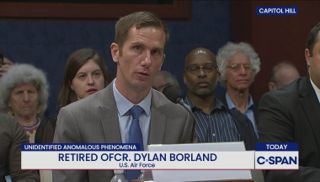
Borland, a former U.S. Air Force geospatial intelligence specialist, appeared alongside UAP researcher and television host Ben Hansen on the Sept. 24, 2026, episode of “Hang Out with Sean Hannity.” Fox News described the discussion as focusing on alleged recovered nonhuman craft, government secrecy and UAP disclosure.
When Hannity asked whether the government possesses recovered craft, Borland answered unequivocally: “Yes, they do,” according to Fox News.
The claim remains publicly unverified. The Pentagon’s All-domain Anomaly Resolution Office, or AARO, has said it found no empirical evidence that the U.S. government or private companies have reverse-engineered extraterrestrial technology.
But perhaps the most intriguing part of Borland’s interview concerned not what the government allegedly possesses, but who — or what — ultimately controls the situation.
“When I went to the ICIG, it was made pretty clear that something else is kind of running the show right now,” Borland said, referring to the Office of the Intelligence Community Inspector General.
__________
__________
Borland also described limits on what he can reveal publicly, effectively leaving journalists to piece together information he says he cannot disclose without risking legal consequences. The discussion subsequently raised the possibility that nonhuman intelligence itself could influence the narrative surrounding Disclosure. Neither proposition has been independently established.
For longtime Unknown Country readers, however, the idea that the government may not actually be “running the show” will sound remarkably familiar.
Related: Grusch, Borland and Brown Seek Public-Disclosure Waivers From Trump →
Whitley Strieber has argued for decades that what he calls the Visitors may themselves control important aspects of secrecy surrounding their presence. In his 2023 book Them, Strieber writes that “from the beginning” it was the Visitors who “orchestrated the secrecy,” maneuvering governments into concealing their presence.
His argument is not that governments bear no responsibility for secrecy. Rather, Strieber believes human institutions are participants in a situation whose fundamental terms may be dictated elsewhere.
He reiterated that distinction in the 2026 edition of Transformation. Governments may attempt to manage or control contact, Strieber writes, but he does not expect the Visitors to enter more public contact simply because a government announces that they exist. In his interpretation, they will do so when they decide the conditions are right.
More recently, during a 2026 interview with Chris Ramsay on Area 52, Strieber said there are also things the Visitors “want to keep secret.” He described his belief, based on his personal experiences, that revealing information they do not want disclosed can carry consequences. That claim, like Borland’s interpretation of his experiences with the intelligence community, cannot be independently verified.
The parallel is nevertheless striking.
Borland approaches the question from the world of classified intelligence and whistleblower testimony. Strieber approaches it through decades of anomalous personal experience. Neither establishes independently that NHI controls Disclosure, and there is currently no publicly verified evidence demonstrating that it does.
But both accounts raise essentially the same question:
What if Disclosure is not entirely ours to give?
If Borland’s allegations prove accurate, the central mystery may extend beyond what governments know or possess. It may involve whether the intelligence behind the phenomenon has its own intentions regarding secrecy — and whether governments are controlling Disclosure or merely participating in a process whose boundaries have been established by something else.
Subscribe to Unknown Country today. Keep the truth coming! Click here to learn more.