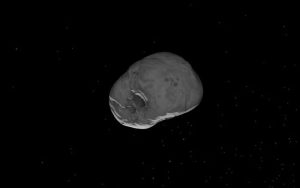
While the chance of it hitting the Earth has been ruled out since its discovery late last year, the city-killer-sized asteroid 2024 YR4 appears to be shaped like a squat disk, more akin to a hockey puck than the usual rounded lump that most asteroids form. This is a concept similar to the one proposed by Galileo Project founder Avi Loeb for our first-known interstellar visitor, ʻOumuamua, based on its observed light profile as it tumbled through space.
First spotted on December 27, 2024, asteroid 2024 YR4’s size falls somewhere between 50 and 70 meters across (164 to 230 feet), just slightly smaller than the estimated size of the object that exploded over Tunguska in 1908. Initially, the asteroid was projected to have a high chance of hitting the Earth on December 22, 2032: as further observations of its orbital path were made, the estimated odds rose as high as 1-in-42 by early February of this year, but subsequent measurements have eliminated the chance that 2024 YR4 will hit us—an event that would have generated an explosion 500 times more powerful than the bombs dropped on Hiroshima and Nagasaki in 1945.
But recent measurements made by the Gemini South telescope network show that 2024 YR4 isn’t the typical rounded shape that one might expect an asteroid to be; instead, it appears to be a hockey puck-shaped disk, roughly three times as wide as it is thick.
“This find was rather unexpected since most asteroids are thought to be shaped like potatoes or toy tops rather than flat disks,” remarked Bryce Bolin, head of the research team lead from Eureka Scientific that made the discovery.
This odd shape would lend credence to the idea that the interstellar object known as ʻOumuamua might have been disk-shaped itself: although it was initially suggested to be the case based on the light it was reflecting as it tumbled through space, the idea was abandoned in favor of the object being cigar-shaped, due to the perceived unlikelihood of an asteroid or comet forming as a disk.
“The most likely model that explains the reflective sunlight as a function of time—as it was doubling every eight hours—was that it has a flat, pancake-like geometry, not cigar-shaped the way it was depicted in some cartoons,” Avi Loeb, former chair of astronomy at Harvard University, explained in a 2021 Salon interview. As it hooked around the Sun in September 2017, ʻOumuamua experienced an unexpected acceleration, something that Loeb says could be explained if the object were a solar sail built by an advanced extraterrestrial civilization.
2 Responses
What I always think of when seeing a discussion about Oumuamua is a concept first mentioned by the late scientist and science fiction writer Arthur C. Clarke: His novel Rama depicts a race of intelligent beings who designed and launched an interstellar spacecraft which was eventually detected by distant spacecraft launched from a future Earth. When the interstellar craft left Earth’s solar system, one of the Earth astrophysicists had a dream — “the Ramans do everything in 3s.” … in other words, the Ramans would have launched not one interstellar craft, but three. So maybe something similar will occur in Earth’s solar system in the future.
Is it coming from the same direction as Oumuamua?