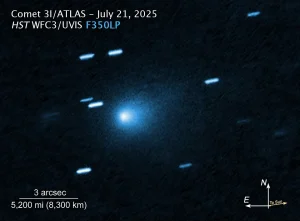
Despite the high probability that the latest interstellar object to pass through our solar system is a comet, 3I/ATLAS is exhibiting odd behavior that runs counter to what astronomers expect of such an object: while it is surrounded with a comet-like cloud of dust and gas, it completely lacks a tail; that gaseous cloud appears to be stretching toward the Sun, instead of being skewed away by the solar wind; and on top of all of that astronomer Avi Loeb has calculated that the object appears to be giving off far more light than it should be, implying that it may be self lit—and possibly artificially so!
3I/ATLAS was first spotted on July 1, 2025, by the Asteroid Terrestrial-impact Last Alert System (ATLAS) survey telescope located in Río Hurtado, Chile, when it was still four-and-a-half times further out from the Sun than the Earth. The object was determined to be travelling at a whopping 61 kilometers (38 miles) per second, nearly twice as fast as 2I/Borisov’s 32 kilometers per second, speeds that ʻOumuamua didn’t reach until it made its close pass to the Sun.
This high rate of speed means that 3I/ATLAS is moving way too fast to be bound by the Sun’s gravity, making this the third interstellar visitor to grace our Solar System in the eight years since ʻOumuamua was first spotted. Images made by the Hubble Space Telescope indicate that the icy nucleus—the solid center of the object—appears to be no larger than 5.6 kilometers (3.5 miles) across, much larger than the previous two interstellar objects detected, with 2I/Borisov being 500 meters (1,641 feet) and ʻOumuamua 400 meters (1,312 feet, provided its shape is cylindrical, or about a quarter of that if it’s disk-shaped).
With its cloud-like coma being made up of water vapor, water ice, carbon dioxide and other elements found in comets, this new object certainly appears to be a comet in terms of its composition, but 3I/ATLAS is striking in that it completely lacks a tail. At its current proximity to the Sun, the solar wind should be blowing a portion of the particles being emitted from the nucleus into a long tail, but astronomers have yet to find one extending from our strange visitor.
It is being suggested that this is “likely due to viewing geometry and low dust production,” meaning that it’s possible that the tail may be pointed directly away from us, or that 3I/ATLAS is simply not emitting material that is affected by the solar wind. Astronomers also caution that 3I/ATLAS might be a late bloomer, and a tail might still form as the currently-bobbed comet draws closer to the Sun.
Also, 3I/ATLAS’s coma appears to be extended slightly toward the Sun, rather than being blown away from it by the pressure exerted by the solar wind. The leading hypothesis is that the Sun is heating 3I/ATLAS’s surface unevenly, resulting in a larger volume of gas being released on the sun-lit side. If this is added to the idea that the individual particles that make up the coma are too massive to be blown away by the solar wind then this would account for why the cloud seems to be pointing in the wrong direction.
But 3I/ATLAS still has at least one more surprise: it appears to be far brighter than it should be, and at least some of this light gives the appearance of coming from within the object itself, rather than being lit entirely by the Sun.
Based on the images generated by Hubble, Harvard University astronomer Avi Loeb calculates that “the luminosity of 3I/ATLAS needs to be of order 10 gigawatt,” a luminosity that would make sense if 3I/ATLAS was over 20 kilometers (miles) wide, as originally estimated, but far too bright for an object only three-eighths that size.
Loeb also found that the falloff of the intensity of the light coming from the coma is also uncharacteristic of what we normally see from comets, with 3I/ATLAS’s light-curve dropping off dramatically the further out from the nucleus one looks, implying that the coma is being lit by the nucleus itself, rather than solely by sunlight; if the light coming from the coma was entirely reflected sunlight, then the cloud would be more evenly lit.
Loeb points out that this rapid falloff might occur if the emitted gases were evaporating rapidly enough to only be visible nearer to the nucleus’ surface, but he cautions that the particles would have to evaporate in about ten minutes, a rate that would be much faster than what we see in ordinary comets.
Loeb offers two equally fascinating explanations for 3I/ATLAS’s self-luminosity: that it might be a “rare fragment from the core of a nearby supernova that is rich in radioactive material” that naturally emits radiation; or that the strange object is a “spacecraft powered by nuclear energy, and the dust emitted from its frontal surface might be from dirt that accumulated on its surface during its interstellar travel.”
Although Loeb appears to favor the nuclear spacecraft hypothesis—the remnant would need to have a surface temperature of at least 1,000 Kelvin (726.85 C° or 1,340.33 F°) to be as bright as it is—he cautions that this explanation “requires better evidence to be viable.”
Although 3I/ATLAS will make its closest approach to the Sun on October 29, it will be on the far side when this occurs, preventing us from gathering data during this critical rendezvous. After emerging from the far side of the Sun it will pass within 269 million kilometers (167 million miles) of the Earth on December 19, offering us a better chance to understand what this strange visitor has to offer.
One Response
This just in from https://spaceweather.com/
NEW JWST IMAGES OF INTERSTELLAR OBJECT 3I/ATLAS: NASA’s James Webb Space Telescope (JWST) has finally taken a look at 3I/ATLAS. Its conclusion? The interstellar visitor looks like a comet, but with a strange chemistry that makes it unlike almost anything seen in our Solar System. Full story @ Spaceweather.com.