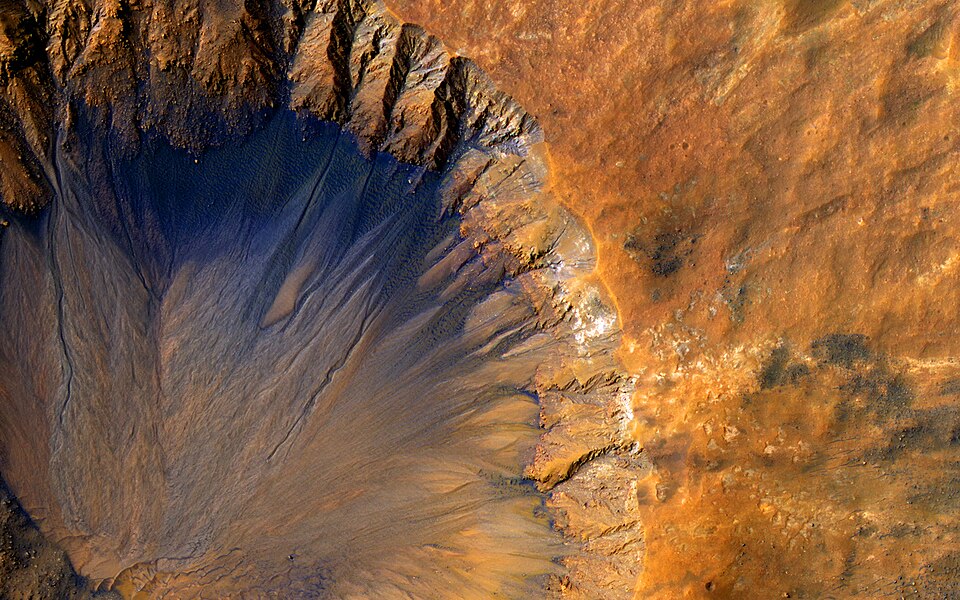
A number of caves that open onto the surface of Mars appear to show evidence that they were formed when water dissolved the minerals that make up the rock formations that they penetrate—and where there’s water, there’s a good chance life might have found a home there at some point in time. Such caves could also be ideal places for life to take shelter from the extremes of the harsh Martian climate, making these caves “prime targets for future human missions.”
Using mineralogical maps compiled from spectrographic data gathered by NASA’s Mars Global Surveyor and Mars Odyssey orbiters, the research team, led by China’s Shenzhen University, analyzed eight caves that sink beneath the surface of Mars’ Hebrus Valles region to determine what minerals make up the rock that the caves formed in.
Although Hebrus Valles is home to numerous sinkholes that were formed when caves carved by subsurface magma flows collapsed, the team’s analysis uncovered the presence of carbonate and sulfate-based minerals in the vicinity of some of these caves, rocks that can be slowly dissolved by water over time, leaving behind what are known as karstic caves. Additionally, the presence of hydrogen was detected around the caves, an indicator that water is or was present there.
“These skylights are interpreted as the first known potential karstic caves on Mars, representing collapse entrances formed through the dissolution of water-soluble lithologies—defining a new cave-forming class distinct from all previously reported volcanic and tectonic skylights,” the study explains.
Adding to the probability that these caves were formed by the exposure of water-soluble minerals to liquid water, the surface features of Hebrus Valles also exhibit evidence of being eroded by flowing water, or “geomorphological indicators of past aqueous activity,” as the study text describes.
On Earth, caves such as these are home to their own vibrant ecosystems that feature myriad species, and there’s reason to believe that if life was present on Mars at any point in the planet’s history, karstic caves would be an ideal habitat. Subterranean environments could also become vital shelters for lifeforms as the Martian climate degraded, growing colder and drier over the eons, and provide ideal shielding as more and more radiation sterilized the Martian surface.
The study authors point out that if the traces of past life—or possibly still-thriving lifeforms—are to be found in these caves, it won’t be by an orbiting spacecraft, but rather “future robotic or human missions” tasked with venturing into the depths of the cave system to discover what’s there.